In 2026, access equipment choices are becoming more evidence-driven. The question is practical: “Why choose a vertical mast lift over a ladder?” A vertical mast lift provides a guarded platform, stable elevation, and room for tools. It also supports two-handed tasks, such as installing lights, checking ductwork, or servicing indoor equipment.
CDC and NIOSH research has estimated that ladder-related injuries send hundreds of thousands of people for medical treatment annually. OSHA continues to identify falls as a leading cause of serious construction injuries and deaths. The IPAF Global Safety Report 2025 also highlights falls from height and MEWP-related operational failures as recurring safety concerns. These findings do not make every lift automatically safer. They show why controlled access matters.
A trained operator can position a vertical mast lift precisely on a firm, level surface. Guardrails reduce the need to climb and reposition repeatedly. Electric models can also work quietly in warehouses, hospitals, and retail spaces. That matters when customers are nearby. Yet a ladder still has a place for brief, low-risk tasks. Sometimes, the lift is unnecessary. That is the uncomfortable part.
The right decision depends on task duration, working height, floor conditions, reach requirements, and operator training. Pre-use inspections remain essential. So are manufacturer instructions and site-specific risk assessments. This article examines where vertical mast lifts offer measurable advantages, where ladders remain practical, and where poor planning can undermine both choices. Safety improves through disciplined decisions, not equipment alone.
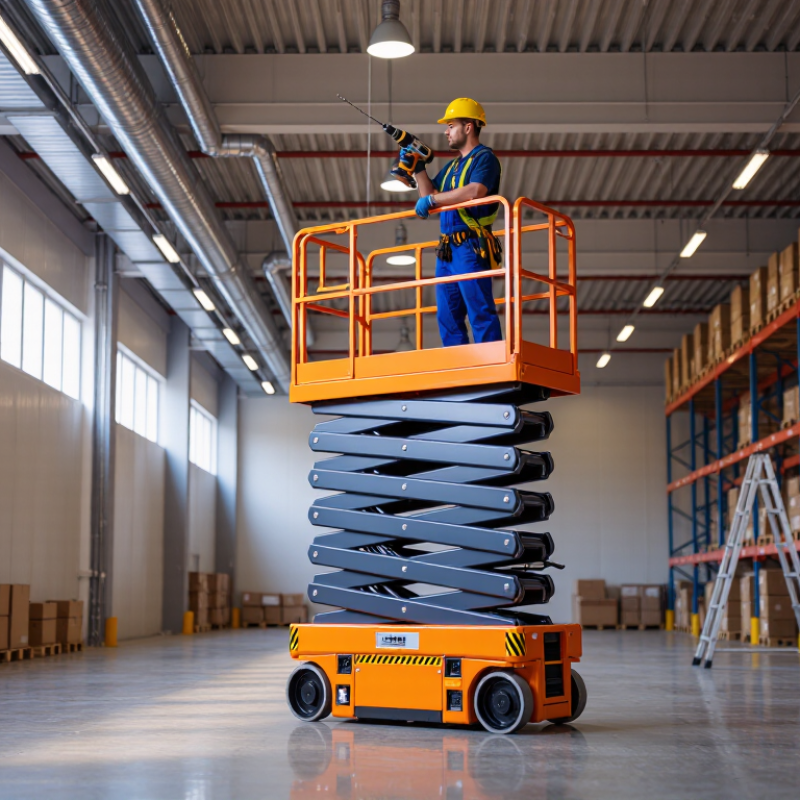
Vertical mast lifts are compact machines designed for controlled work at elevated positions. Many models provide approximately 20–40 feet of platform or working height, depending on configuration. Unlike a ladder, the operator stands inside a guarded platform with dedicated controls. That extra stability can matter when installing lights, checking overhead equipment, or handling light tools.
ANSI A92.20 focuses on design requirements, stability, guarding, load limits, and safety-related testing for mobile elevating work platforms. It does not replace site-specific training or safe-use procedures. Those details still require careful attention.
A lift may meet its design standard, yet become hazardous on uneven ground, near edges, or under overhead obstructions. In practice, operators should verify the manual, rated capacity, platform height, and emergency-lowering method before work begins. A taller machine is not automatically the better machine.
Tips: Measure the actual work height, not just the ceiling height. Check doorways, floor strength, and turning space first. Keep both feet on the platform floor. Never use rails as a climbing step. Inspect tires, controls, guardrails, and alarms before each shift. Wind can also change the risk outdoors. This point is often underestimated. If the task needs frequent repositioning, a mast lift may improve workflow, but it still demands patience and honest site assessment.
In 2026, vertical mast lifts deserve attention because ladder falls remain a serious workplace hazard. OSHA reports cited in safety discussions indicate that ladders are involved in 43% of fatal falls. That figure is difficult to ignore when a worker stands on a narrow rung, reaches sideways, and carries tools several meters above a concrete floor. A small shift in balance can become a life-changing event.
A vertical mast lift provides a guarded platform, controlled elevation, and more stable positioning for overhead tasks. Workers can keep both feet on the deck instead of stretching from a ladder. The platform also offers room for essential tools, reducing repeated climbing. From my practical safety perspective, this can improve posture and reduce rushed movements during lighting, inspection, maintenance, and installation work.
Still, a lift is not automatically safer. It requires trained operators, pre-use inspections, firm ground, proper access, and respect for its rated capacity. Guardrails must remain secured, and workers should follow the equipment manual rather than improvise. A ladder may remain reasonable for brief, low-level work, but that decision deserves honest review. Are workers climbing because it is suitable, or because it is nearby? That question is often overlooked. A vertical mast lift cannot remove every risk, yet it can create a more controlled working position when the task lasts longer or demands frequent reaching.
2026 Top Vertical Mast Lift: Why Choose It Over a Ladder?
A vertical mast lift can provide a more controlled work platform than a ladder. Its guardrails help create a physical boundary around the worker. A self-closing gate or secured access point reduces fall exposure during entry and exit. The platform also gives workers room to position tools without leaning far outside the rails.
Three-point contact still matters. OSHA 1926.1053 requires workers to maintain safe ladder practices, including facing the ladder while climbing and using a handhold. However, this standard addresses ladders, not every requirement for vertical mast lifts. Lift users must also follow the equipment manual, site procedures, inspection rules, and applicable fall-protection requirements. Never stand on guardrails. Never use a lift platform as an improvised ladder.
On a busy site, stable positioning can reduce awkward reaching and repeated climbing. That can lower fatigue, especially when tasks involve overhead lighting, ductwork, or indoor maintenance. Before operation, inspect guardrails, wheels, controls, emergency lowering systems, and the floor surface. Watch for uneven ground, door thresholds, overhead hazards, and nearby traffic.
A lift is not automatically safer. Poor training can defeat good design. That uncomfortable detail deserves attention. Experienced supervisors should confirm worker authorization, conduct a pre-use inspection, and stop work when conditions change. A ladder may still suit brief, light tasks, but a guarded platform often offers better working access and body positioning.
| Evaluation Dimension | Portable Extension Ladder | Vertical Mast Lift | Practical Safety and Selection Implication |
|---|---|---|---|
| Primary work position | Standing on ladder rungs; balance depends on hand contact and body position. | Standing on a guarded work platform designed for elevated access. | A lift generally provides a more stable working position for tasks requiring both hands, subject to the manufacturer’s operating instructions and site risk assessment. |
| Fall-protection arrangement | The ladder itself does not provide a surrounding guardrail system. Personal fall protection may be required by the task, site rules, or applicable standard. | Typically includes a platform guardrail system, toe boards or equivalent edge protection where specified, and a self-closing entrance or chain depending on the design. | Guardrails reduce the likelihood of stepping or falling from the platform, but they do not eliminate the need to follow access, gate, and fall-protection requirements. |
| Three-point contact | Climbers should maintain two hands and one foot, or two feet and one hand, whenever climbing, while facing the ladder. | Three-point contact is required during ladder access to the platform; once inside, the worker can use both hands while remaining within the guarded platform. | The lift separates climbing from the main work activity, which can improve control when installing, inspecting, or servicing overhead components. |
| Access to an upper landing | When used for access to an upper landing, the ladder must extend at least 3 ft (0.9 m) above the landing surface, or an equivalent safe handhold must be provided and the ladder secured. | Normally accesses the work height through an integrated platform entrance and internal steps or ladder. | A lift is usually better suited to work from a platform; a ladder is often better suited to short-duration access when no safer practical method is available. |
| Setup geometry | For a non-self-supporting ladder, the horizontal distance from the top support to the foot is commonly set at approximately one-quarter of the working ladder length, known as the 4:1 rule. | The mast remains vertical through the machine’s base; the unit must be placed on a firm, level surface within the manufacturer’s slope and surface limits. | A lift reduces manual setup and angle errors, but uneven ground, holes, slopes, overhead obstructions, and floor loading must still be assessed. |
| Typical working reach | Reach depends on ladder length and safe standing position. The top step of a portable stepladder must not be used as a step, and overreaching can cause loss of balance. | Common vertical mast lift configurations provide approximately 20–40 ft (6–12 m) of platform height; exact height varies by model and configuration. | Select by required platform height and allowable horizontal reach; do not climb rails or use boxes, ladders, or improvised extensions on the platform. |
| Work duration and productivity | Best for light, short-duration work with limited tools and materials. | Better suited to repetitive or longer-duration overhead work requiring a stable platform and frequent repositioning. | Reduced climbing and repositioning can lower fatigue, but productivity gains depend on access, charging or fueling, and floor conditions. |
| Typical platform capacity | The ladder’s duty rating must cover the worker, clothing, tools, and materials. The ladder must never be loaded beyond its marked capacity. | Many compact vertical mast lifts are rated around 300–500 lb (136–227 kg), but the exact rated platform capacity must be taken from the machine data plate and manual. | Count every occupant, tool, material, and accessory. Capacity can change with platform extensions or configuration. |
| Mobility and repositioning | Light and easy to carry, but the worker must descend before moving the ladder. | Many units are battery-powered and self-propelled or pushable, allowing repositioning from the platform only when the manufacturer permits it and the surface is suitable. | Never move an elevated unit unless the operating manual specifically allows it under the stated conditions. |
| OSHA ladder requirements | OSHA 29 CFR 1926.1053 addresses ladder construction, use, inspection, setup, access to landings, facing the ladder, and carrying loads. | 1926.1053 applies to ladder components and access where relevant; it is not a complete operating standard for every powered lift configuration. | Use the applicable OSHA requirements for the equipment category, plus the manufacturer’s instructions, employer program, and local regulations. |
| Inspection before use | Inspect rails, rungs, feet, locks, spreaders, contamination, damage, and visible defects before use. Remove defective ladders from service. | Inspect controls, emergency lowering, guardrails, gate, tires or casters, battery, alarms, hydraulic or electric systems, and structural components before use. | Document inspections according to the employer’s program and equipment instructions; tag out equipment with safety-critical defects. |
| Overhead and electrical hazards | Maintain required clearance from energized lines and identify doors, piping, beams, and other overhead hazards. | The elevated platform and mast can enter overhead hazards; verify clearances, line locations, door heights, and travel paths before elevation. | A lift improves platform stability but does not protect against electrocution, crushing, entanglement, or struck-by hazards. |
| Best-use decision | Short-duration, low-complexity tasks where the ladder can be placed securely and the worker can maintain safe body position. | Frequent or extended elevated work requiring both hands, controlled positioning, a guarded platform, and repeated access to the same work zone. | Choose the vertical mast lift when it materially improves stability and task control; choose a ladder only after confirming that it is suitable for the task and conditions. |
2026 Top Vertical Mast Lift: Why Choose It Over a Ladder?
A vertical mast lift can change daily access work from repeated climbing to controlled platform movement. Its 500-pound platform capacity supports two workers with tools, but teams must confirm the rated load before every task. A ladder usually serves one person and requires frequent repositioning. That lost time becomes noticeable across a full shift.
Two-person access improves productivity during lighting, inspection, and installation work. One worker can handle the task while the other manages tools or checks alignment. Zero-turn capability also helps in narrow aisles and crowded indoor areas. Operators can make tight movements without dragging equipment across the floor. Still, the lift is not automatically faster. Charging, training, and surface checks can affect the real result.
Tips: Keep the load balanced and include tools in the 500-pound calculation. Inspect floors for holes, slopes, debris, and wet spots before moving. Use the platform gate correctly, and never treat the guardrails as a ladder. Verify clearance near ceilings, doors, and overhead services. A short route plan prevents unnecessary turns. Measure actual cycle time on your site. That evidence is more useful than a brochure claim. Some projects may still favor a ladder for brief, low-risk access. That is worth admitting.
2026 Top Vertical Mast Lift: Why Choose It Over a Ladder?
A vertical mast lift offers a steadier working position than a ladder. That matters when tools, materials, or both hands are needed. The CDC reports that ladders are involved in about 43% of fatal falls among workers. A guarded platform cannot remove every hazard, but it can reduce unsafe leaning and repeated repositioning.
Platform height should match the real task, not the maximum number on a brochure. Measure the floor, ceiling, overhead obstructions, and the worker’s reach. Leave clearance beneath sprinklers and lighting. OSHA guidance emphasizes maintaining safe distances from energized equipment, so electrical work requires careful site assessment. A small mistake here can be expensive.
Doorway access is another practical test. A 32-inch doorway may accept some compact lifts, but turning space, thresholds, and platform rails can still block movement. Measure the narrowest point, including door hardware. Battery runtime also deserves skepticism. The IPAF Global Powered Access Rental Market Report highlights utilization and productivity as major rental considerations, yet runtime changes with load, floor condition, temperature, and charging habits. Compare the rated duty cycle with your actual shift. A full-day claim may assume light use. That assumption is easy to miss. Check recharge time, battery condition indicators, and whether opportunity charging is permitted by the operating instructions. Personally, I would test the lift through a complete shift before approving a purchase. Specification sheets are useful, but real floors are less forgiving.
2026 buying criteria: platform height, 32-in doorways, and battery runtime
A vertical mast lift can provide a stable elevated work platform, powered positioning, and extended battery operation for repeated indoor tasks. The benchmarks below are practical buying targets: approximately 24 ft of platform height, maximum width of 32 in for standard door access, and about 8 hours of operating runtime. Actual specifications vary by configuration, load, surface, and work cycle.
It is a compact machine for controlled elevated work. The operator stands inside a guarded platform with dedicated controls. Many models reach about 20–40 feet.
A guarded platform supports both feet during overhead work. It can reduce sideways reaching and repeated climbing. That may improve posture and workflow. Not always.
ANSI A92.20 covers design, stability, guarding, load limits, and safety-related testing. It does not replace training or site-specific procedures. Compliance alone cannot correct poor ground conditions.
Check tires, controls, alarms, guardrails, wheels, and emergency-lowering systems. Inspect the floor surface and platform access. Small defects deserve attention.
Measure the actual work height, not only the ceiling height. Check doorways, floor strength, turning space, and door thresholds. Identify edges, overhead obstacles, and nearby traffic.
It may work outdoors when conditions suit the equipment. Wind can increase risk, especially at elevated positions. Uneven ground also matters. This risk is easy to underestimate.
Keep both feet on the platform floor. Never stand on guardrails or use them as steps. Keep the gate secured and follow the equipment manual.
No. It creates a more controlled position, but hazards remain. Training, inspections, stable ground, and rated-capacity limits still matter. I may sound cautious, but rushed decisions cause trouble.
A ladder may suit brief, light, low-level work. Workers should review that choice honestly. Is it suitable, or merely nearby? That question is often missed.
Vertical mast lifts offer a safer, more productive alternative to traditional ladders for many elevated work tasks. Designed under ANSI A92.20 guidelines, these compact machines can provide approximately 20–40 feet of working reach while offering a stable platform, guardrails, and controlled movement. Why choose a vertical mast lift over a ladder? Ladder-related falls remain a major workplace concern, and OSHA reports that ladders are involved in 43% of fatal falls. A lift helps reduce reliance on constant three-point contact while supporting safer work-at-height practices aligned with OSHA 1926.1053 requirements.
Beyond safety, vertical mast lifts improve efficiency with platforms rated for up to 500 pounds, room for two workers, and zero-turn maneuverability in tight spaces. When choosing a 2026 model, consider platform height, access through 32-inch doorways, battery runtime, platform capacity, and indoor operating conditions. These factors help match the equipment to the job while reducing setup time and improving access in challenging work areas.

Kathy lift